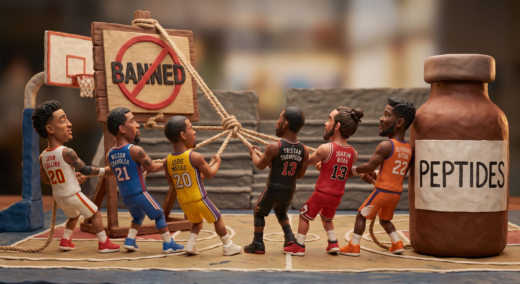
Over the years, the NBA’s Anti-Drug Program has maintained strict, zero-tolerance policies regarding Performance-Enhancing Drugs (PEDs), peptides, growth hormone secretagogues, and selective androgen receptor modulators (SARMs).
However, as current regulatory bodies and the FDA begin re-evaluating and loosening restrictions on various amino-acid chains and secretagogues, the conversation surrounding athletic bans is changing. While these compounds remain strictly banned across major professional sports leagues—including the NBA—the historic disciplinary actions taken against players highlight how heavily the league monitored peptide and growth-hormone compound usage before any regulatory shift took place.
Below is a look at notable NBA players who received significant league suspensions after testing positive for peptides, peptide-adjacent compounds, or performance-enhancing agents.
Key NBA Suspensions Involving Peptides & Hormonal Modulators
- John Collins
In November 2019, Atlanta Hawks forward John Collins received a 25-game suspension after testing positive for GHRP-2 (Growth Hormone Releasing Peptide-2). GHRP-2 is a synthetic peptide engineered to stimulate the body’s natural production of human growth hormone, often associated with enhanced recovery, appetite stimulation, and increased food intake. - Wilson Chandler
During the summer of 2019, Brooklyn Nets forward Wilson Chandler was handed a 25-game ban following a positive test for Ipamorelin. Ipamorelin is a selective growth hormone secretagogue peptide that signals the pituitary gland to release growth hormone, aiding tissue repair and recovery without sparking cortisol spikes. - Jodie Meeks
In April 2018, Washington Wizards guard Jodie Meeks was suspended for 25 games after testing positive for two separate peptide compounds: Ipamorelin and GHRP-2. The dual infraction sidelined him through the end of the regular season and the entirety of the 2018 NBA playoffs. - Tristan Thompson
Cleveland Cavaliers center Tristan Thompson was hit with a 25-game suspension in January 2024. The NBA champion tested positive for ibutamoren (MK-677) alongside SARM-like metabolites. While frequently categorized alongside peptide therapies, ibutamoren is technically a non-peptidic growth hormone secretagogue that mimics the gut hormone ghrelin to trigger endogenous growth hormone release. - Joakim Noah
In March 2017, New York Knicks center Joakim Noah was suspended for 20 games for testing positive for LGD-4033 (Ligandrol). Though technically classified as a Selective Androgen Receptor Modulator (SARM) rather than a peptide, LGD-4033 exhibits testosterone-like anabolic properties and is governed under the same anti-doping umbrella as peptide and hormone-modulating enforcement. - DeAndre Ayton
While not a peptide, Phoenix Suns center DeAndre Ayton served a 25-game suspension in October 2019 after testing positive for a banned diuretic. Diuretics are strictly policed under the NBA anti-doping policy because they are frequently utilized as masking agents to dilute or flush out evidence of peptides, anabolic steroids, and other short-acting PEDs.
The Evolution of the Rulebook
While medical discussions around peptide therapies continue to evolve outside of sports, the NBA and the National Basketball Players Association (NBPA) continue to categorize all unapproved peptide secretagogues, SARMs, and masking diuretics as explicit violations of Article XXXIII in the league’s Collective Bargaining Agreement (CBA). Even as public and clinical interest in amino-acid chain therapies grows, the league continues to enforce immediate 25-game suspensions for first-time offenders.