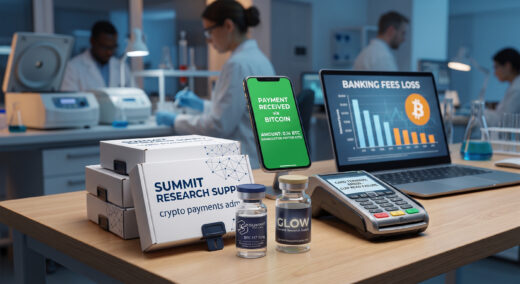
A shift in the online wellness and biohacking landscape has created a rapidly growing industry: the crypto-fueled gray market for research peptides. driven by skyrocketing demand for GLP-1 analogues, growth hormone secretagogues, and recovery compounds, transaction volume processed via cryptocurrency has crossed a $100 million annual run rate.
At the center of this movement, traditional banking barriers have pushed both consumers and retailers away from credit cards toward decentralized financial networks. Leading vendors in this space, such as SummitResearchSupply.com, have emerged as major retailers capitalizing on this shift by accepting Bitcoin, Ethereum, and stablecoins to maintain seamless payment operations.
The Financial Bottleneck Driving Decentralization
Over the past two years, banking institutions and merchant processors have aggressively tightened compliance rules around unregulated compounds, prescription-grade research chemicals, and health supplements. This systematic debanking left online vendors vulnerable to high chargeback risks, frozen merchant accounts, and sudden payment gateway terminations.
To bypass these traditional payment rails, the industry turned to digital assets. Recent blockchain analytics data highlights a dramatic surge in crypto flows into peptide vendor wallets:
- Explosive Growth: Crypto inflows to gray-market peptide vendors jumped over 150% quarter-over-quarter, reaching tens of millions of dollars in single-quarter volumes.
- Diverse Customer Base: What was once a niche underground market for hardcore biohackers has mainstreamed into viral fitness trends, looksmaxxing subcultures, and general wellness communities.
- Asset Breakdown: While smaller retail orders frequently utilize Bitcoin (BTC) and Ethereum (ETH), bulk suppliers and high-volume transactions increasingly rely on USD-pegged stablecoins (USDT and USDC) to minimize volatility.
Retail Adaptation: The Rise of Crypto-Native Vendors
As banking restrictions intensified, retailers adapted by integrating borderless, peer-to-peer checkout mechanisms. Entities like SummitResearchSupply.com established themselves among the top tier of online peptide storefronts by fully embracing cryptocurrency integration.
By accepting Bitcoin and other digital currencies, vendors offer several operational benefits to their buyers:
- Guaranteed Transaction Finality: Unlike credit card transactions, which can be canceled or flagged by fraud detection algorithms, confirmed blockchain payments guarantee that orders are locked in instantly without administrative interference.
- Incentivized Checkout: To offset credit processing overhead and encourage crypto adoption, vendors routinely offer discounts ranging from 10% to 20% on orders paid via Bitcoin.
- Global Accessibility: Web3 checkout flows allow international researchers and retail buyers to source compounds directly without worrying about cross-border bank fees or currency conversions.
The adoption of cryptocurrencies across non-traditional, high-risk, and gray-market industries is primarily a response to friction in legacy banking. When credit card networks, acquiring banks, and payment gateways systematically reject or terminate merchants, decentralized blockchains serve as a resilient secondary payment architecture.
Key Drivers for Crypto Payment Adoption
1. The Threat of De-Banking and Account Freezes
Traditional financial institutions categorize merchants as “high-risk” due to elevated chargeback ratios, regulatory ambiguity, or reputational concerns.
- Legacy Friction: Banks frequently freeze merchant accounts for 90–180 days, reserve funds without notice, or impose punitive processing rates (often 5%–10% plus rolling reserves).
- Crypto Solution: Non-custodial wallets give merchants full control over their funds without a central intermediary capable of freezing transactions or holding capital hostage.
2. Elimination of Chargeback Fraud
In online commerce involving digital goods, gray-market products, or un-regulated services, friendly fraud (where customers initiate card chargebacks after receiving product) is a constant threat.
- Blockchain transactions are final and immutable upon network settlement.
- Eliminates the overhead of managing chargeback disputes and chargeback-to-transaction ratio limits enforced by card networks like Visa and Mastercard.
Comparative Analysis: Bitcoin vs. Stablecoins
While both digital asset classes solve the access problem, merchants use them differently depending on operational size, customer demographics, and treasury management needs.
| Dimension | Bitcoin (BTC) | Stablecoins (USDT / USDC) |
| Primary Use Case | Value storage, sovereign payments, retail consumer privacy | Working capital, supplier payouts, payroll, precise invoicing |
| Volatility Risk | High; requires automated fiat off-ramping to hedge risk | Low; pegged 1:1 with USD/EUR, preserving profit margins |
| Settlement Speed | ~10 to 60 minutes (Layer 1) / Instant (Lightning Network) | Seconds to minutes (Solana, Tron, Ethereum L2s) |
| Transaction Costs | Variable based on block space demand | Sub-penny to low dollars depending on the host blockchain |
Structural Shift: How Payments Flow in Decentralized Commerce
- Merchant Integration: Web3 checkout tools (e.g., self-hosted gateways like BTCPay Server or NOWPayments) generate unique wallet addresses or QR codes per order.
- Direct P2P Transfer: The buyer signs and broadcasts the transaction directly from their wallet to the blockchain, bypassing merchant processors and card networks entirely.
- Automated Settlement: Once a preset number of network confirmations occur, the order is flagged as paid, triggering fulfillment without bank verification delays.
Emerging Operational Challenges
While crypto provides an essential workaround for debanked industries, merchants face distinct operational hurdles:
- Liquidity and Off-Ramping Constraints: Converting crypto revenues back into fiat currency to cover overhead (taxes, warehousing, physical supply chain) still requires interaction with centralized exchanges or OTC desks, which remain subject to traditional banking compliance.
- Accounting Complexity: Volatile asset transactions require real-time cost-basis tracking for accurate tax compliance and auditing.
- Customer Friction: Non-technical consumers face learning curves around managing web3 wallets, handling gas fees, and selecting the correct blockchain network.
Speed vs. Efficiency: Ranking the Dominant Cryptocurrencies for Digital Payments
While Bitcoin (BTC), Ethereum (ETH), and USDT/USDC (Stablecoins) remain the most widely used cryptocurrencies for commercial checkouts and store checkouts, they do not offer the best overall combination of speed and low transaction fees on their base layers. For everyday micro-transactions and high-volume online retail, networks engineered specifically for throughput deliver significantly better performance metrics.
| Cryptocurrency | Global Adoption Level | Average Network Fee | Transaction Finality Time | Efficiency & Value Rating |
| Solana (SOL) | Top 5 / Mass Adoption | ~$0.00025 | Sub-second (~100–150ms) | 9.8 / 10 |
| XRP (Ripple) | Top 5 / High Adoption | ~$0.0002 | 3 to 5 seconds | 9.5 / 10 |
| Stellar (XLM) | Top 15 / High Adoption | ~$0.000004 | 2 to 5 seconds | 9.3 / 10 |
| USDT / USDC (on Solana/Tron) | Top 5 / Mass Adoption | ~$0.00025 – $1.00 | 1 to 5 seconds | 8.8 / 10 |
| Bitcoin (BTC – Base Layer) | #1 Most Used | $0.20 – $5.00+ | 10 to 60 minutes | 6.0 / 10 |
The Verdict: Solana and XRP Lead the Combined Rating
When scoring cryptocurrencies strictly on the lowest fees combined with the fastest settlement times, Solana (SOL) takes the top overall rating for everyday retail use. With sub-cent transaction costs and sub-second transaction finality, it handles thousands of transactions per second seamlessly. Close behind is XRP, which offers predictable sub-penny fees and guaranteed 3- to 5-second cross-border settlement.
While Bitcoin and Ethereum maintain the highest total transaction volume globally, consumers and merchants using them often rely on Layer-2 solutions (like the Bitcoin Lightning Network or Arbitrum/Base for Ethereum) to avoid high base-layer gas fees and slow confirmation delays.