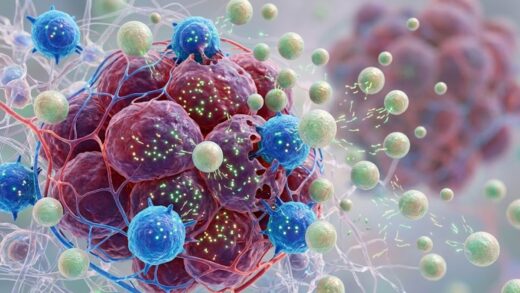
Scientists in Singapore have developed microscopic peptide-based droplets that can deliver gene-silencing molecules into cancer and immune cells, significantly reducing tumor growth in mice, according to a new study.
The research, led by Nanyang Technological University (NTU Singapore) and published in the journal Biomaterials, found that the experimental system reduced colorectal tumor growth by around 67% in mouse models.
Researchers say the approach could offer a lower-cost and more flexible alternative to some existing cancer immunotherapies, although it is still at an early experimental stage.
How the technology works
The system uses tiny peptide “microdroplets” designed to carry small interfering RNA (siRNA) into cells. siRNA is a genetic material that can switch off specific genes by breaking down messenger RNA before proteins are produced.
In this study, the treatment targeted two proteins involved in helping cancer cells avoid immune attack: PD-1 and PD-L1. These proteins normally interact to send a “stop signal” that weakens the immune response against tumors.
Instead of blocking these proteins with antibodies, as current immunotherapy drugs do, the NTU approach reduces their production inside the cells.
One formulation targets immune T cells to reduce PD-1, while another targets cancer cells to reduce PD-L1. Together, the dual approach strengthens the immune system’s ability to attack tumors.
Results in mice
In laboratory tests, the combined treatment reduced tumor growth by about 67% in mice with colorectal cancer. Researchers reported that the results were comparable to existing antibody-based checkpoint inhibitor treatments used as a benchmark.
The system also increased immune activity, helping T cells kill more cancer cells in experiments.
The study focused on a difficult-to-treat form of colorectal cancer known as microsatellite-stable (MSS) tumors, which make up about 85% of cases and typically respond poorly to immunotherapy.
Potential advantages and next steps
Researchers say the peptide droplet system may offer several potential advantages over current treatments.
Unlike monoclonal antibodies, which are large and complex to produce, siRNA-based therapies can be chemically manufactured and modified more easily. The team estimates production could be five to ten times cheaper if successfully developed for clinical use.
The droplets may also improve how RNA medicines are delivered into cells, a key challenge in the field.
However, scientists caution that the findings are still early-stage. The treatment has only been tested in animals, and further studies are needed to assess safety, dosing, and long-term effects in larger models before human trials can be considered.
Wider context
Colorectal cancer is one of the most common cancers globally, with more than 1.9 million new cases and over 900,000 deaths recorded in 2022.
Researchers say new approaches are urgently needed, especially for patients whose tumors do not respond to current immunotherapy drugs.