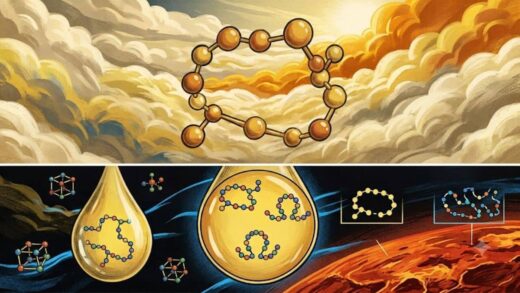
Scientists have found that peptides—short chains of amino acids—can remain structurally stable in extremely acidic environments similar to those found in the clouds of Venus, raising new possibilities in the search for life beyond Earth.
The findings, reported by researchers at the Massachusetts Institute of Technology (MIT), suggest that peptide molecules may not only survive but also maintain stable 3D structures in highly concentrated sulfuric acid. This challenges the long-held assumption that such molecules would quickly break apart under these conditions.
Peptides survive extreme acid conditions in lab tests
In laboratory experiments, researchers tested short peptide chains in environments containing up to 98% sulfuric acid. Contrary to expectations, the peptide structures remained intact for extended periods and showed no signs of chemical breakdown.
Using nuclear magnetic resonance (NMR) spectroscopy, the team observed that the peptides formed stable folded shapes that persisted for weeks without significant structural change. Researchers described the shape as a stable loop-like structure influenced by the surrounding acid environment.
Traditionally, scientists believed peptides would rapidly degrade in strong acids due to hydrolysis, a process that breaks chemical bonds in water-rich conditions. However, the study suggests that in very low-water environments, this breakdown process may not occur in the same way.
Implications for Venus and alternative biochemistry
The results are significant for astrobiology, particularly in the study of Venus’s upper atmosphere, where clouds contain concentrated sulfuric acid. Scientists have previously speculated that such environments could support alternative forms of biochemistry not dependent on water.
Researchers involved in the study say that peptides may adopt stable structures in these acid environments due to electrostatic interactions with sulfuric acid molecules, which help maintain their shape.
Experts in the field have described the findings as notable because they show that protein-like structures could exist in conditions previously thought to be completely hostile to biological chemistry.
Broader impact on search for life
Astrobiologists say the results could widen the scope of environments considered potentially habitable. Instead of focusing only on water-based systems, researchers are increasingly examining whether other solvents, such as sulfuric acid, could support complex molecular structures.
While the study does not claim evidence of life on Venus, it provides experimental support for the idea that essential biological building blocks may be more chemically adaptable than previously believed.
Scientists say further research is needed to understand how longer peptide chains behave and whether sequence differences affect stability in such extreme conditions.