If you’ve spent time in biohacking circles, longevity podcasts, or HIV treatment forums over the last decade, you’ve probably run into tesamorelin. Unlike most of the peptides swirling around gray-market research chemical sites, this one has a real prescribing label and a real clinical trial history behind it.
Sold under the brand name Egrifta, tesamorelin has built a reputation as the peptide that targets the fat that matters most — the visceral fat wrapped around your internal organs. But its story is more layered than a single approval letter suggests. It has a genuine mechanism rooted in your own hormonal machinery, a narrow and specific clinical purpose, and a growing off-label following among biohackers and anti-aging clinics that has, in practice, drifted well past what it was ever studied for.
So what is tesamorelin, really? Below is a deep dive into where it came from, how it works, what the clinical data actually shows, and where the science ends and the hype begins.
1. Quick Take: What Exactly Is Tesamorelin?
Tesamorelin is a synthetic peptide built from 44 amino acids, engineered to mimic and amplify the body’s own growth hormone-releasing hormone (GHRH).
The Chemical Nature
- It reproduces the natural GHRH sequence produced by the hypothalamus.
- Chemists attached a hexenoyl (trans-3-hexenoic acid) group to the N-terminus of the molecule.
- That modification protects the peptide from being rapidly broken down by the enzyme DPP-4, extending its usable half-life enough to make once-daily dosing viable.
The Big Picture
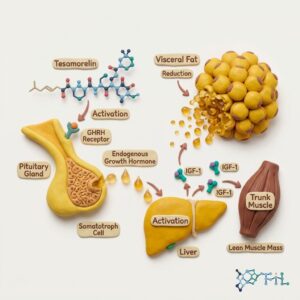
This is the critical distinction that separates tesamorelin from a fragment peptide like AOD-9604. AOD-9604 acts directly on fat cells as an isolated fragment. Tesamorelin doesn’t touch fat tissue directly at all — it works several steps upstream, signaling the pituitary gland to release the body’s own growth hormone in a natural, pulsatile pattern.
Regulatory Status
- Approved by the FDA in November 2010, under the brand name Egrifta, specifically to reduce excess visceral abdominal fat in HIV patients with lipodystrophy. (U.S. Food and Drug Administration — Egrifta prescribing information, Application Number 22-505)
- That’s a materially different category than the unapproved research peptides most of this space runs on — it comes with an official prescribing label, dosing guidelines, and post-marketing surveillance requirements. But as we’ll talk about it later, the approval is narrower than the compound’s off-label reputation suggests.
| Feature | Detail |
|---|---|
| Amino acid length | 44 |
| Drug class | Growth hormone-releasing hormone (GHRH) analog |
| Brand name | Egrifta / Egrifta SV |
| FDA approval | November 10, 2010 |
| Administration | Once-daily subcutaneous injection |
| Approved indication | Reduction of excess visceral fat in HIV-associated lipodystrophy |
2. The Origin Story: How Tesamorelin Was Developed
The Company Behind It
Tesamorelin was developed by Theratechnologies, a Montreal-based biopharmaceutical company, and later commercialized in the US through a partnership with EMD Serono. (Theratechnologies / EMD Serono FDA approval announcement, November 2010)
The Problem It Was Built to Solve
The story of tesamorelin can’t be separated from the HIV epidemic and the rise of antiretroviral therapy. Early combination antiretroviral regimens in the late 1990s and 2000s were truly groundbreaking, and one of the main reasons why the virus went from a death sentence to something almost “manageable” nowadays.
But they also came with an unwelcome side effect: lipodystrophy. That means patients developed a distinctive pattern of fat redistribution, losing fat in the face and limbs while accumulating dense, hard visceral fat around the abdominal organs. This wasn’t just a cosmetic problem. Visceral fat accumulation in these patients was tied to metabolic and cardiovascular risk, and it became a significant quality-of-life and health concern as HIV shifted from a fatal diagnosis to a manageable chronic condition.
The Search for a Safer Growth Hormone Strategy
Doctors already knew that growth hormone reduces visceral fat. But injecting synthetic growth hormone directly carries real downsides: it overrides the body’s natural feedback loops, drives blood sugar up, and can push IGF-1 to unsafe levels. Researchers needed a way to boost the body’s own growth hormone output without hijacking the entire system.
That’s the gap tesamorelin was designed to fill — stimulate the pituitary to do what it already does naturally, just more of it.
Clinical Milestones
- Early-stage trials established the pharmacokinetic profile and confirmed the hexenoyl modification extended the peptide’s activity enough for daily dosing.
- Two pivotal Phase 3, multicenter, randomized, double-blind, placebo-controlled trials enrolled a combined total of over 800 HIV-infected adults with lipodystrophy, each running a 26-week main phase followed by a 26-week extension. (Falutz, J., et al. (2010), Phase 3 trial data on tesamorelin and body composition in HIV-associated lipodystrophy, JAIDS)
- Both trials demonstrated statistically significant reductions in visceral adipose tissue (VAT) and waist circumference compared to placebo. (Falutz, J., et al. (2010), JAIDS)
- The FDA approved Egrifta on November 10, 2010, making it the first and still only approved treatment for HIV-associated lipodystrophy — and, notably, the approval was for that specific patient population, not for fat loss in general. (U.S. Food and Drug Administration — Egrifta prescribing information, Application Number 22-505)
3. Mechanism of Action: How It Works in the Body
The GHRH-GH-IGF-1 Axis
Tesamorelin binds to GHRH receptors on somatotroph cells in the anterior pituitary gland. This triggers the pituitary to release growth hormone in the same pulsatile pattern the body would produce on its own — just at a higher amplitude.
That growth hormone then travels to the liver and other tissues, where it stimulates the production of IGF-1 (insulin-like growth factor 1), the downstream messenger largely responsible for growth hormone’s tissue effects, including lipolysis in visceral fat.
Why Pulsatile Matters
This is the mechanistic heart of why tesamorelin is considered safer than injecting growth hormone directly. Synthetic hGH floods the body with a constant, non-physiological hormone level and shuts down the body’s own natural GHRH signaling through negative feedback.
Tesamorelin instead works with the existing feedback loop, encouraging a rhythm the pituitary already knows how to run, which is thought to reduce (though not eliminate) the risk of the blood sugar disturbances and fluid retention associated with direct hGH use.
How It Compares to Other Metabolic Peptides
| Pathway / Feature | Tesamorelin (GHRH Analog) | AOD-9604 (hGH Fragment) | Full Synthetic hGH |
|---|---|---|---|
| Primary mechanism | Stimulates the pituitary to release natural, pulsatile GH | Directly triggers lipolysis via a localized fragment sequence | Directly floods the body with synthetic, constant GH |
| Pituitary suppression | No — preserves natural feedback loops | No interaction with the pituitary | Yes — exogenous GH suppresses natural production |
| IGF-1 impact | Moderate elevation, generally within physiological range | Essentially no impact on IGF-1 | High, and often disproportionate, elevation |
| Visceral fat loss | Clinically proven in Phase 3 trials | Mixed and inconsistent in human data | General, non-selective fat loss |
| Insulin/glucose risk | Requires monitoring; growth hormone counters insulin | None reported — glucose-neutral | High risk of insulin resistance and hyperglycemia |
| FDA status | Approved (2010), specific indication | Unapproved investigational compound | Approved for distinct, separate indications |
Why clinical medicine says it is “Not for Weight Loss”
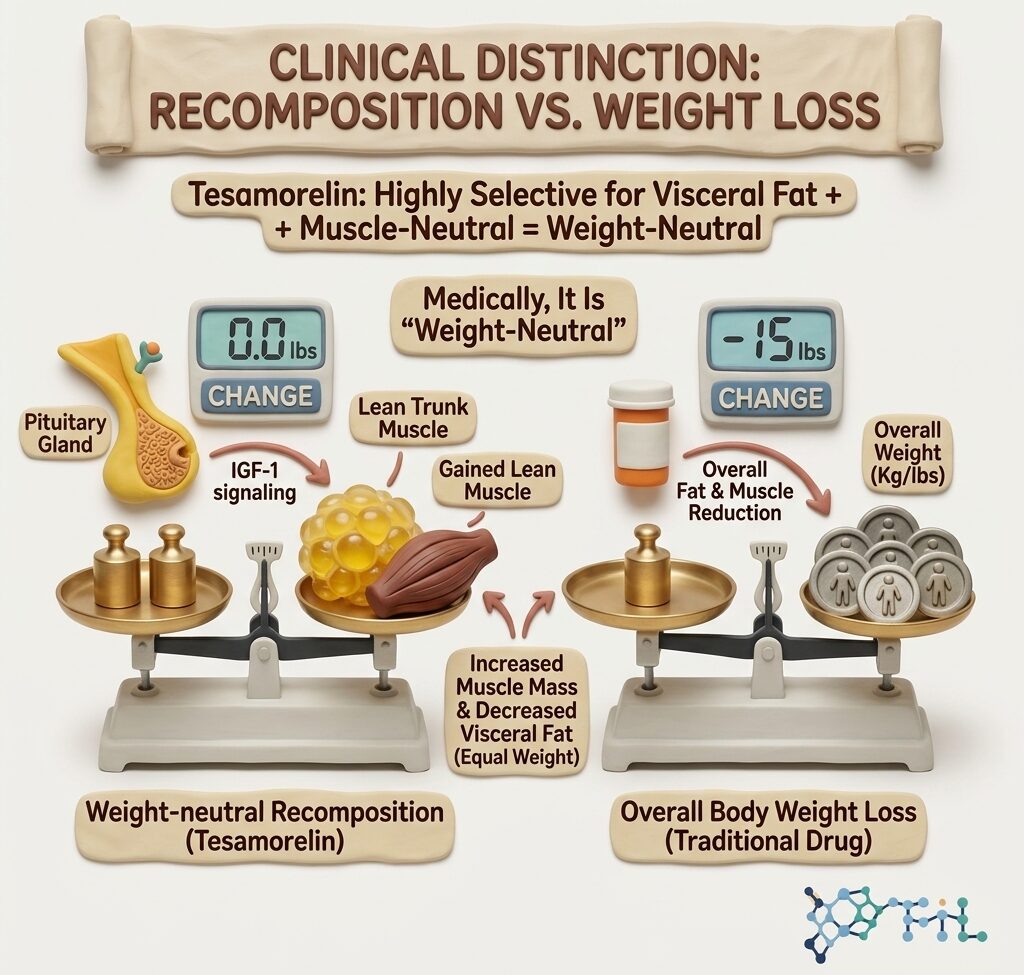
When the FDA or medical guidelines evaluate a weight-loss drug (like semaglutide/Wegovy), they look for a significant drop in overall body weight.
- Tesamorelin does not change the number on the scale.
- It is highly selective. It goes after deep visceral fat (the beer-belly fat wrapped around your organs).
- At the same time, because it elevates growth hormone, it preserves or slightly increases lean muscle mass.
- Because muscle weighs more than fat, patients in trials lost inches off their waistlines but stayed the exact same weight. Therefore, medically, it is classified as “weight-neutral.“
4. Key Therapeutic Uses & Scientific Evidence
Visceral Fat Reduction — The Clinical Standard
This remains tesamorelin’s only FDA-approved use, and it’s backed by the strongest data of anything on this list.
- The two pivotal Phase 3 trials showed visceral adipose tissue reductions in the range of roughly 15–18% relative to placebo over 26 to 52 weeks of treatment. (Falutz, J., et al. (2010), JAIDS; Falutz, J., et al. (2011), Long-term safety and effects of tesamorelin in HIV-infected patients with abdominal fat accumulation, AIDS)
- Reductions were measured using CT imaging at the L4–L5 vertebral level, a standard method for quantifying visceral fat. (U.S. Food and Drug Administration — Egrifta prescribing information, Application Number 22-505)
- Alongside VAT reduction, trials reported favorable shifts in triglycerides and non-HDL cholesterol, both markers tied to cardiovascular risk in this patient population. (Falutz, J., et al. (2010), JAIDS)
Why visceral fat specifically matters: unlike the subcutaneous fat sitting just under the skin, visceral fat wraps around the liver, intestines, and other organs. It’s metabolically active tissue that secretes inflammatory cytokines and is far more strongly linked to insulin resistance, cardiovascular disease, and metabolic syndrome than subcutaneous fat is.
The detail that surprises most people: the FDA label is explicit that Egrifta is not indicated for general weight loss and has an overall weight-neutral effect. Rather, it redistributes fat rather than melting it away — patients in the pivotal trials often gained lean mass in the trunk even as visceral fat dropped, which is a very different result than the “fat loss peptide” framing implies.
Cognitive Function and Brain Health — The Emerging Frontier
A separate, smaller body of research has explored whether raising GHRH activity could support brain health in older adults, independent of the HIV/lipodystrophy indication.
- A randomized, placebo-controlled trial led by Laura Baker and colleagues, published in Archives of Neurology in 2012, tested tesamorelin in 152 older adults aged 55 to 87, some cognitively healthy and some with mild cognitive impairment (MCI). (Baker, L.D., et al. (2012), Effects of growth hormone-releasing hormone on cognitive function in adults with mild cognitive impairment and healthy older adults, Archives of Neurology)
- Over 20 weeks of daily dosing, participants saw meaningful increases in IGF-1 levels alongside improvements in executive function, with some benefit also observed in verbal memory among the MCI group. (Baker, L.D., et al. (2012), Archives of Neurology)
- Follow-up work from the same research group linked the treatment to changes in brain GABA levels and shifts in a metabolite associated with Alzheimer’s pathology. (Friedman, S.D., et al. (2013), follow-up neuroimaging study on GHRH and brain metabolites)
This research remains investigational. It has not led to a new FDA indication, and it involved a study population and dosing protocol distinct from the approved lipodystrophy use. Still, it’s a big part of why interest in tesamorelin has spread well beyond HIV clinics.
5. The Biohacking & Fitness “Off-Label” Reality
Why the Longevity World Took Notice
Once word spread that a GHRH analog could meaningfully cut visceral fat while nudging IGF-1 up in a controlled way, tesamorelin found a second life among anti-aging clinics, concierge medicine practices, and biohackers chasing a leaner midsection without giving up muscle mass.
- Body composition appeal: Because it raises growth hormone in a pulsatile, more physiological way, tesamorelin has developed a reputation among off-label users for leaning out the abdominal area while preserving lean tissue — a very different profile from the muscle-wasting risk associated with aggressive caloric restriction alone.
- The steady IGF-1 rise: Advocates point to the more gradual, controlled IGF-1 increase as the reason it’s perceived as gentler than direct hGH use, though the FDA label itself does not endorse this use case.
The Narrow-Approval, Wide-Use Gap
This is where tesamorelin’s story gets genuinely interesting rather than just promotional. The compound’s entire clinical evidence base was built in one specific population: HIV patients with a specific, hormonally-driven fat redistribution pattern. Clinicians who prescribe or discuss it off-label are candid that this creates real uncertainty when it’s used outside that context — a healthy 45-year-old chasing a flatter stomach is a fundamentally different physiological starting point than the trial population the drug was proven in, and there simply isn’t equivalent trial data for that use case.
- The Phase 3 trials didn’t measure tesamorelin’s effect on people without HIV-associated lipodystrophy, so claims about its performance in general fat loss are extrapolated, not demonstrated.
- Response also appears to hinge heavily on baseline GH/IGF-1 status — people with already-adequate growth hormone output have less room for a GHRH stimulant to do meaningful work, which likely explains some of the inconsistency reported anecdotally in off-label use.
- Because the compound doesn’t touch appetite or overall energy balance, it does the least for someone who isn’t already managing their diet and training — the visceral fat effect shown in trials assumes a baseline of general metabolic management, not a substitute for it.
The Catch
- Egrifta is expensive as a branded pharmaceutical, and insurance coverage is generally limited to its approved HIV indication — off-label users are typically paying out of pocket at a significant premium.
- It requires a daily subcutaneous injection, a real adherence barrier for anyone using it outside a structured medical protocol.
- Effects are not permanent — visceral fat tends to return toward baseline once treatment stops, meaning it functions more like an ongoing therapy than a one-time fix.
- Off-label sourcing exposes users to the same purity, dosing accuracy, and quality-control risks associated with any peptide obtained outside a licensed pharmacy.
6. Side Effects, Safety, and Clinical Realities
| Category | What to Know |
|---|---|
| Injection site reactions | Redness, itching, or swelling — the most commonly reported adverse events in trials |
| Fluid retention & joint symptoms | Arthralgia and carpal-tunnel-like sensations can occur due to elevated GH activity, though generally milder than with full synthetic hGH |
| Glucose regulation | Growth hormone naturally counters insulin’s effects, so blood sugar should be monitored, particularly in anyone with pre-diabetes or diabetes |
| Contraindications | Not to be used by anyone with active malignancy, given IGF-1’s role in promoting cell growth and proliferation |
| Long-term cardiovascular data | The prescribing label is explicit that long-term cardiovascular benefit and safety have not been established (U.S. Food and Drug Administration — Egrifta prescribing information, Application Number 22-505) |
| Weight loss claims | Explicitly not indicated for general weight management — its effect is body-composition-specific and weight-neutral overall (U.S. Food and Drug Administration — Egrifta prescribing information, Application Number 22-505) |
Other reported adverse events from the pivotal trials include mild headache, muscle pain, and, in some patients, changes in blood glucose consistent with growth hormone’s known effect on insulin sensitivity. As with any long-term hormonal therapy, monitoring through a prescribing physician is standard practice rather than optional.
7. Frequently Asked Questions
Is tesamorelin the same as growth hormone? No. Tesamorelin doesn’t add growth hormone to your system directly. It stimulates your pituitary gland to release more of your own, in the pulsatile rhythm your body already uses.
Does tesamorelin cause weight loss? Not in the general sense. Its FDA label specifically notes it’s weight-neutral and is not approved for weight management — its documented effect is a reduction in visceral fat specifically, not overall body weight.
Can healthy people without HIV use tesamorelin? It is only FDA-approved for HIV-associated lipodystrophy. Any other use, including for cosmetic fat loss or cognitive support, is off-label and outside its approved indication.
How is it different from AOD-9604? AOD-9604 is an isolated fragment of growth hormone that (in theory) acts directly on fat cells and has never gained FDA approval. Tesamorelin is a full GHRH analog that works upstream at the pituitary and has genuine FDA approval behind it, backed by large Phase 3 trials.
8. The Bottom Line
Tesamorelin occupies a genuinely interesting space in the peptide world: a compound with replicated Phase 3 clinical trial data behind it, built to solve a specific and serious problem in HIV care rather than reverse-engineered from a fitness trend. That clinical pedigree is real, and it’s why the compound gets taken more seriously in medical circles than most peptides sold under research-chemical labels.
But the evidence base is exactly as wide as its approved use — visceral fat reduction in HIV-associated lipodystrophy — and no wider. Its expansion into biohacking, body composition, and cognitive-health circles is where the interesting open questions live, not where the settled science is. Anyone considering it outside its approved indication should be working with a licensed physician who can weigh the hormonal mechanism against the real gaps in population-specific and long-term data — not against the marketing framing.
Most Popular Tesamorelin Topics on Peptides TIL today:
|
What Is Tesamorelin? The Complete Insider's Guide to the Visceral Fat-Melting Peptide
2 views
|
|
| Explore All Articles and Listicles covering Popular Tesamorelin Topics & Searches | |