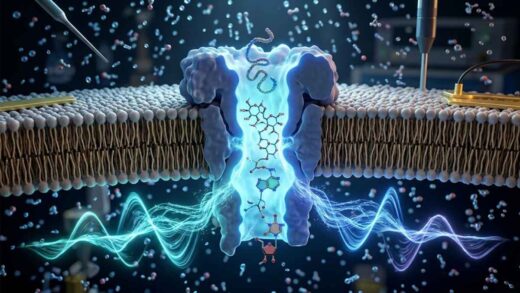
A new study published in Nature Biotechnology reports a major step toward what researchers call a “universal molecular sensing platform”—a single engineered nanopore system capable of identifying four fundamental classes of biomolecules: amino acids, peptides, saccharides, and ribonucleotides.
The work, led by researchers at Nanjing University and collaborators, combines engineered protein nanopores with machine learning to create a system that can distinguish individual molecular signals at the single-molecule level. In practice, it moves nanopore technology closer to a general-purpose chemical reader for biology.
A single nanopore that reads life’s basic chemistry
Nanopores are tiny protein or synthetic channels that allow molecules to pass through one at a time. As each molecule moves through the pore under an electrical voltage, it produces a unique disruption in ionic current. These “current signatures” can be measured and analyzed.
In this study, the researchers engineered a modified MspA nanopore and functionalized it with chemical adaptors that improve molecular recognition. This allowed the system to interact differently with:
- 20+ amino acids (including modified forms)
- Nucleoside monophosphates (A, U, C, G and epigenetic variants)
- Simple sugars (saccharides)
- Short peptides
Each class produces distinct electrical “event patterns,” enabling discrimination at high resolution.
Machine learning turns signals into molecular identification
Instead of relying only on raw electrical traces, the team trained machine learning models on thousands of nanopore event features. These included:
- Current blockage depth
- Signal variability (standard deviation)
- Temporal characteristics
- Statistical shape features of each event
Using a bagged tree ensemble model, the system achieved high classification accuracy (reported ~98% in validation tests) across multiple biomolecule categories.
This combination of engineered sensing and AI classification is key to the platform’s flexibility. Rather than designing a separate sensor for each molecule type, the same nanopore can be “interpreted” differently depending on training data.
Beyond single molecules: peptides and biological mixtures
One of the most significant demonstrations in the study is the system’s ability to detect peptides and complex biological mixtures.
The researchers showed that:
- Short peptides can be distinguished from individual amino acids
- Glycosylated peptides produce recognizable disruption patterns
- Enzymatic digestion can reveal hidden molecular structures
- Even yeast cell extracts generate identifiable molecular signals
This suggests potential applications in proteomics, metabolomics, and even real-time biochemical diagnostics.
Why this matters: toward a universal biomolecular reader
Current molecular analysis typically requires multiple specialized tools:
- Mass spectrometry for proteins and peptides
- Chromatography for metabolites
- Sequencing systems for nucleotides
- Separate assays for sugars and glycans
This nanopore system aims to unify parts of that workflow into a single sensing platform.
If further developed, it could enable:
- Portable biochemical analyzers
- Faster clinical diagnostics
- Real-time monitoring of metabolic changes
- More efficient drug discovery pipelines
The role of nanotechnology and AI convergence
The study reflects a broader trend in biotechnology: merging nanoscale physical systems with machine learning interpretation.
Nanopores provide the raw physical signal, while AI models convert noisy, overlapping electrical patterns into structured biochemical identity. Without machine learning, many of these molecular signals would be too similar to reliably distinguish.
Still early, but highly scalable potential
Despite the promise, the authors note limitations. Nanopore signals can be influenced by experimental conditions, and real-world biological samples are far more complex than controlled lab mixtures. Stability, calibration, and scaling remain key engineering challenges.
However, the concept is powerful: instead of building many sensors for many molecules, build one adaptable sensor and let software do the identification.
The bigger picture
If refined, this approach could represent a shift toward “general molecular readers”—devices that do for biochemistry what universal sensors did for physics measurements.
A single platform that can identify amino acids, sugars, nucleotides, and peptides would bridge major gaps between genomics, proteomics, and metabolomics, bringing them closer to a unified analytical system.
For now, the study marks an important proof-of-concept: biology’s fundamental building blocks can be read by one engineered nanopore system, guided by machine learning.