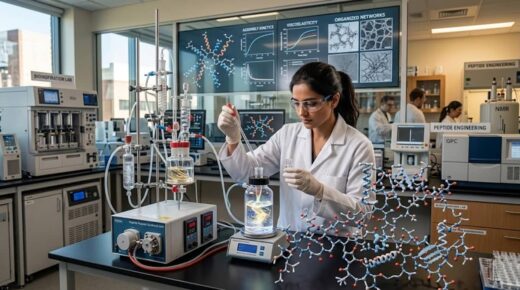
Researchers at Stanford University say they may have found a new way to fight antibiotic-resistant bacteria, using artificial intelligence to design polymer-based drugs that mimic the bacteria-killing power of peptides.
Antibiotic resistance is a growing global problem. Many existing drugs target specific pathways inside bacteria, which allows microbes to adapt and eventually survive. Peptides, however, work differently. These small proteins attack bacteria physically by disrupting their cell membranes, making it far harder for resistance to develop.
“Peptides essentially punch holes in bacterial membranes,” said Eric Appel, senior author of the study. “It is much harder for bacteria to change their entire membrane structure than to adapt to a traditional drug.”
Despite their potential, peptides are not ideal medicines. They break down quickly in the body and are expensive to produce at scale. That has limited their real-world use.
To overcome this, the Stanford team turned to polymers. These long, chain-like molecules are cheaper, more stable, and easier to manufacture. The goal was to design polymers that behave like peptides but without their drawbacks.
Using AI, researchers screened a massive library of 1.7 million possible polymer structures. Because there is limited data on antimicrobial polymers, the team first trained their model using data from known antimicrobial peptides. They then applied those insights to predict which polymers might work in a similar way.
The approach paid off. After narrowing down candidates and testing them in the lab, the team identified 10 polymers that showed strong antibacterial activity against E. coli. One candidate was especially effective against biofilms, which are clusters of bacteria that are difficult to treat with conventional antibiotics.
The key advantage of these polymers is how they kill bacteria. Instead of targeting a specific biological pathway, they physically disrupt the cell membrane. This reduces the chance that bacteria will develop resistance.
The study also suggests these polymers could be tailored to target specific types of bacteria. That could allow future treatments to eliminate harmful microbes while leaving beneficial bacteria unharmed.
Researchers say the findings are still at an early stage, but the results are promising. With further development, this AI-driven approach could lead to a new class of antibiotics that are cheaper, more durable, and less prone to resistance.
As antibiotic resistance continues to rise worldwide, the need for new treatment strategies is urgent. This research points to a potential shift in how antibiotics are designed, moving from traditional chemical targeting to physically disruptive mechanisms.
2 Responses