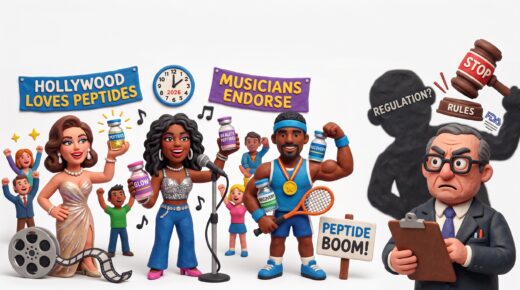
As 2026 comes to a close, the global wellness and beauty landscape has been utterly transformed by a single, powerful buzzword: peptides. From the meticulously curated skincare routines of Grammy-winning artists to the elite recovery protocols of legendary athletes, these microscopic chains of amino acids have become the holy grail of anti-aging, performance, and aesthetic optimization. But as top Hollywood stars, musicians, and athletes proudly display their peptide-infused results, a critical question is echoing through medical and legal corridors: Is this overwhelming celebrity endorsement the ultimate omen before sweeping federal regulation?
For years, peptides lingered in the shadows of the wellness industry. Classified largely as “research chemicals” and whispered about in niche bodybuilding forums or exclusive anti-aging clinics, compounds like BPC-157, TB-500, and GHK-Cu were kept well out of the mainstream spotlight. Today, that script has been entirely flipped. Synthetic signaling molecules are now front and center, endorsed by the most recognizable faces on the planet.
Hollywood’s Embrace: Aniston’s Wellness Revolution
The cultural shift arguably reached critical mass when Jennifer Aniston openly discussed her reliance on injectable peptides. In a candid revelation that sent shockwaves through the anti-aging community, the Hollywood icon described her weekly peptide treatments as the “future” of skin regeneration and cellular health. Aniston, already a chief creative officer and the highly visible face of Vital Proteins collagen, bridged the gap between over-the-counter dietary supplements and clinical bio-optimization.
By casually linking her age-defying appearance to these amino acid chains—which act as cellular messengers, signaling the body to repair damage, reduce systemic inflammation, and boost natural firmness—Aniston effectively normalized a practice that the U.S. Food and Drug Administration (FDA) has yet to officially approve for general anti-aging. Her endorsement added massive star power to an industry already quietly generating billions, proving that peptides had successfully crossed the rubicon from experimental science into standard Hollywood beauty protocols.
The Beauty Empire Pivot: Rihanna and Cardi B
If Aniston normalized the injectables, the titans of the music industry have commodified the topicals. Rihanna, always at the vanguard of cultural and cosmetic shifts, has deeply embedded peptide science into the next era of Fenty Beauty. Moving far beyond simple hydration, her skincare line now boasts target-driven formulations like the Thicc N Smooth Rich Peptide Eye Cream. By utilizing synthetic peptides such as GHK-Cu (Copper Tripeptide-1) and Matrixyl 3000, Fenty is delivering biomimetic signaling molecules directly to the consumer. These ingredients instruct the skin’s extracellular matrix to ramp up collagen synthesis and cellular renewal.
Rihanna isn’t the only chart-topper cashing in on the topical peptide gold rush. Cardi B has recently become a highly influential force in the space, triggering massive viral sales for advanced Korean skincare and cosmetic lines. Her enthusiastic endorsement of BIOHEAL BOH’s Probioderm 3D Lifting Cream—a rich facial night cream packed with a formidable 17-Peptide Complex—sent consumers scrambling for overnight contouring. Cardi B has also actively promoted SKINTIFIC’s Peptide Brightening Lip Serum, highlighting how targeted peptides and Vitamin C can plump, hydrate, and restore cellular volume to the lips without the need for invasive fillers. When artists with this level of global influence push biochemistry-backed beauty, the market listens, and synthetic peptides rapidly move from the research lab to everyday retail shelves.
Science Meets Style: Beyoncé’s Haircare Breakthrough
The peptide revolution isn’t limited to skin and muscle; it is actively rewriting the rules of textured hair care. Global sensation Beyoncé has utilized her brand, Cécred, to introduce the restorative power of target-specific peptides to the global haircare market. Her flagship Restoring Hair & Edge Drops rely on advanced bio-molecular technology, specifically Biopeptide-5 and Biotinoyl Tripeptide-1, to target follicle rejuvenation.
For Black culture, this represents a monumental shift. Historically, textured hair care relied heavily on surface-level oils and thick, butter-heavy sealants. Beyoncé’s peptide-infused serum tackles the root cause of edge thinning and tension alopecia at a cellular level. Cosmetic chemists note that these peptides act as cellular messengers, instructing the hair follicle to remain in the anagen (growth) phase longer while strengthening the dermal-epidermal junction where the root takes hold. By actively anchoring the hair root, boosting micro-circulation, and inhibiting localized DHT activity, Beyoncé’s foray into peptide science is offering real, measurable restoration for hairlines and edges, fundamentally elevating the standard for textured hair products.
The Athletic Edge: Serena Williams and Corey Maggette
While the beauty industry capitalizes on topical applications, the sports world is leaning heavily into the systemic, regenerative power of injectable peptides. At age 44, tennis legend Serena Williams shocked the world by hitting the US Open court with a rejuvenated physique and unyielding stamina. Her secret? A highly structured peptide therapy protocol. Williams has publicly embraced advanced compounds such as BPC-157 (known for its rapid tissue healing properties), TB-500, and GLP-1 agonists to rebuild muscle integrity, soothe chronic joint inflammation, and manage her physical conditioning during her high-profile comeback.
Similarly, former NBA star Corey Maggette has become a walking billboard for the anti-aging benefits of these compounds. Now well into his mid-forties, Maggette’s skin, muscle density, and overall physique reportedly look twenty years younger. Relying on customized peptide stacks paired with rigorous daily exercise, Maggette demonstrates how these biological messengers can essentially hack the aging process, allowing retired athletes to maintain peak physiological conditions long after their professional careers have ended.
The Omen Before Regulation
As 2026 draws to a close, the sheer visibility of peptides is a double-edged sword. On one hand, the endorsements from Aniston, Rihanna, Beyoncé, Cardi B, Williams, and Maggette have democratized access to information about bio-optimization and molecular-level health. On the other hand, this blazing spotlight is drawing intense scrutiny from federal regulators.
Currently, the peptide market exists in a highly precarious regulatory gray area. While topical cosmetic peptides (like those sold by Fenty or Cécred) are perfectly legal and safe for retail, the injectable therapies favored by elite athletes and Hollywood stars are largely unapproved for over-the-counter human administration. Many of these systemic compounds are sourced through a decentralized network of research supply companies, legally sold only under the strict caveat of “for research purposes only.”
Health boards across the country have begun taking notice. States like Mississippi have recently issued rare joint warnings to medical providers regarding the unregulated use of research-grade peptides, and the FDA has historically taken a cautious approach, focusing on cracking down on bad actors rather than issuing blanket approvals. However, the celebrity-driven explosion in consumer demand is creating a massive, unregulated gray market. Unverified suppliers are flooding the internet, selling unadulterated peptide strings without proper batch-purity testing, posing severe contamination risks to the general public.
Is this A-list spotlight the omen before regulation? Industry insiders believe it is. When high-net-worth individuals and global icons push a fringe science into the mainstream, it inevitably forces the hand of regulatory agencies. The FDA can no longer ignore a multi-billion-dollar industry that is being openly advertised on the red carpet, at the US Open, and in viral beauty campaigns.
As we look toward 2027, the peptide landscape is poised for a dramatic reckoning. The compounds have undeniably proven their efficacy, fundamentally changing how we approach skin health, hair restoration, and elite athletic recovery. But as the gap between celebrity bio-hacking and mainstream consumer demand continues to close, the Wild West era of peptides is likely nearing its end. Regulation is no longer a distant possibility; driven by the very stars who championed the science, it is becoming an imminent reality.