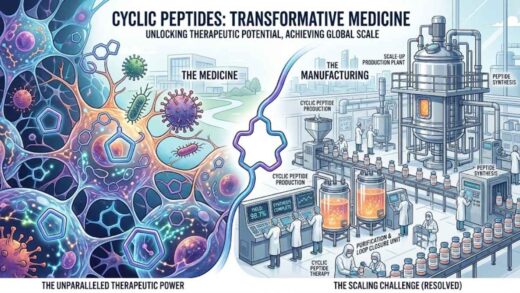
Cyclic peptides are rapidly emerging as one of the most promising frontiers in modern drug development, driven by the success of GLP-1 therapies in obesity and diabetes treatment. But while scientific excitement is accelerating, the industry is running into a hard reality: making these molecules at scale is extremely complex, expensive, and sensitive to small changes in production conditions.
Experts from Viva Biotech told BioSpace Insights that cyclic peptides could reshape drug discovery, but only if manufacturing technologies evolve fast enough to match demand.
Why cyclic peptides matter
Peptides are short chains of amino acids, forming the building blocks of many biological processes. Cyclic peptides, where the chain is chemically closed into a loop, offer several advantages over linear peptides:
- Greater stability in the body
- Improved binding to difficult drug targets
- Potential oral availability in some cases
- Ability to target “undruggable” proteins
These properties make them especially attractive for diseases where small molecules and antibodies fall short.
However, real-world performance is still limited by poor bioavailability. Even promising cyclic peptides often show absorption rates below 1%, far lower than traditional small-molecule drugs.
Manufacturing: where complexity becomes a barrier
Despite their therapeutic promise, cyclic peptides are notoriously difficult to manufacture.
Experts highlight several key challenges in Solid Phase Peptide Synthesis (SPPS):
- Multi-step synthesis (often 30+ steps for longer chains)
- Falling coupling efficiency as chains grow
- Formation of side products and impurities
- Heavy reliance on expensive purification processes
- Sensitivity to temperature shifts as small as 5°C
Even minor variations in reactor conditions, mixing, or resin behavior can significantly change final product purity.
In large-scale production, these inefficiencies translate into:
- Lower yields (often 30–60% purity before refinement)
- High production costs
- Complex purification workflows like chromatography and lyophilization
- Increased risk of batch failure
For commercial drug manufacturing, this creates major financial and operational risk.
Hybrid synthesis: a step toward scalability
To address these challenges, companies like Viva Biotech are adopting hybrid synthesis strategies, combining:
- Solid-phase peptide synthesis (SPPS)
- Liquid-phase synthesis for fragment assembly
Instead of building a full peptide chain step-by-step, shorter high-purity fragments are synthesized separately and then linked together.
This approach can:
- Improve overall yield
- Reduce cost and risk
- Enable scale-up to hundreds of kilograms
- Achieve higher final purity (reported up to 99% in GLP-1 programs)
AI is changing peptide drug development
Artificial intelligence is now becoming central to peptide engineering and manufacturing.
According to Viva Biotech researchers, AI tools can:
- Predict reaction failures and impurity formation
- Optimize multi-parameter synthesis conditions
- Model peptide structure and stability
- Improve pharmacokinetic (PK) predictions
- Reduce development costs by 20–40% in some workflows
Instead of sequential trial-and-error, AI allows parallel evaluation of peptide properties such as binding, stability, permeability, and toxicity.
Machine learning is also helping bridge a major gap in the field: limited experimental data on cyclic peptides, especially for human pharmacokinetics.
The bioavailability problem remains unsolved
Even with advanced design and synthesis tools, cyclic peptides still face a key limitation: delivery inside the human body.
Challenges include:
- Rapid degradation by enzymes (e.g., DPP-4)
- Poor membrane permeability
- Extremely low oral absorption
- Limited clinical pharmacokinetic datasets
This makes in vivo performance unpredictable, even when lab binding affinity is strong.
Experts emphasize that drug success depends more on stability and clearance than binding strength alone.
A new drug class with huge potential
Despite these limitations, cyclic peptides are considered a “sweet spot” in drug design.
They sit between:
- Small molecules (good oral availability, limited targeting ability)
- Antibodies (high specificity, poor cell penetration)
Cyclic peptides can potentially combine:
- High selectivity
- Ability to target intracellular pathways
- Flexibility in chemical design
- Possibility of oral drug development in the future
They are especially promising for diseases involving protein–protein interactions that are difficult to block with traditional drugs.
The road ahead: from discovery to manufacturing revolution
The future of cyclic peptide therapeutics will depend on more than just discovery science.
Key developments expected in the next decade include:
- Fully automated peptide synthesis platforms
- Continuous flow manufacturing systems
- Improved building blocks and amino acid libraries
- AI-driven end-to-end drug design pipelines
- Better integration of discovery and manufacturing teams
Industry experts stress that successful peptide drugs will require alignment between early-stage design and large-scale production from the beginning.
Conclusion
Cyclic peptides are emerging as one of the most exciting drug classes in modern biotechnology. They offer a unique balance of precision, versatility, and therapeutic potential.
But their future depends on solving a fundamental problem: manufacturing at scale without losing efficiency, purity, or predictability.
With AI, hybrid synthesis methods, and improved chemical engineering, the gap between discovery and production may finally begin to close — unlocking the next wave of peptide-based medicines.