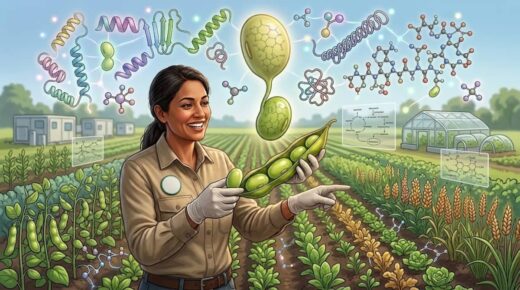
Researchers have identified a peptide-based communication system in plants that appears to control how seeds develop — and early experiments suggest it may even be used to produce larger crop seeds.
The study, led by the The Sainsbury Laboratory in collaboration with the École Normale Supérieure de Lyon, was published in Science and uncovers a previously unknown signaling pathway between two key seed tissues: the embryo and the endosperm.
At the center of this discovery is a peptide called PIPL7 and a receptor known as IKU2 (also referred to as HAIKU2). The embryo produces the PIPL7 peptide, which is then detected by IKU2 in the surrounding endosperm — the nutrient-rich tissue that supports seed growth.
This signaling acts like a developmental “conversation” between tissues, helping coordinate growth so that seeds form properly and develop in balance.
Researchers originally studying plant immune and stress signaling stumbled upon the pathway while mapping where different peptides and receptors are expressed in plant tissues. They noticed unusually strong activity of PIPL7 in developing seeds, prompting deeper investigation.
Further genetic and molecular tests confirmed that PIPL7 is the missing ligand for IKU2, solving a question that had remained open for more than two decades about what activates this receptor.
When either the peptide or receptor was disrupted, plants showed abnormal seed development, reinforcing the idea that this signaling system is essential for normal seed formation.
Importantly, the two components of the system are expressed in different parts of the seed: the embryo produces PIPL7, while IKU2 is active in the endosperm. This separation allows controlled communication between the tissues during development.
The most notable finding came from early proof-of-concept experiments in crop plants. When researchers increased PIPL7 activity, the plants produced larger seeds, suggesting that this pathway could potentially be targeted to improve agricultural yields.
While the research is still in early stages and mainly conducted in Arabidopsis thaliana, the results point toward a possible new tool for crop engineering — one based not on traditional growth hormones, but on precise peptide signaling between seed tissues.
The team has also filed a patent related to the discovery, indicating potential future applications in agriculture and plant biotechnology.
2 Responses