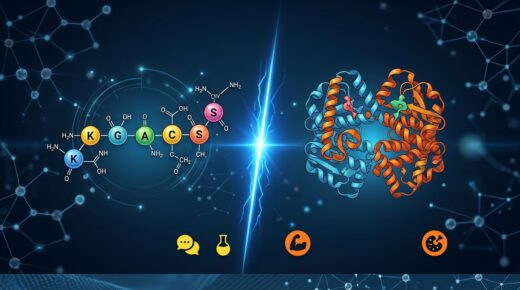
Peptides and proteins share the same building blocks, but they play very different roles in biology. Peptides are short chains of amino acids that often act as messengers, while proteins are longer, folded chains that serve as the machinery of life. Understanding the distinction helps explain why peptides are gaining attention in medicine and wellness.
The Basics
Both peptides and proteins are made of amino acids linked by peptide bonds. As Chemistry LibreTexts notes, amino acids connect through condensation reactions to form chains with a free amino end and a free carboxyl end. The difference is length: peptides usually contain between 2 and 50 amino acids, while proteins are 50 or more.
Structure and Complexity
Proteins fold into secondary, tertiary, and quaternary structures, stabilized by hydrogen bonds and hydration. This folding gives them complex shapes that allow them to act as enzymes, transporters, or structural components. Peptides, being shorter, typically remain linear or adopt simpler conformations. Clinical Peptide points out that the dividing line is conventional rather than absolute, but the functional difference is clear: peptides are simpler, proteins are more complex.
Roles in the Body
Peptides often act as signals. Oxytocin, a nine‑amino‑acid peptide, regulates social bonding. GLP‑1, a 30‑amino‑acid peptide, influences insulin release. These short chains tell other systems what to do. Proteins, by contrast, execute the work. Hemoglobin, with 574 amino acids, transports oxygen. Collagen provides structural support. Antibodies defend against pathogens. As PeptideJournal summarizes, peptides are “messengers,” proteins are “machines.”
Why the Distinction Matters
For therapeutics, peptides are easier to synthesize and often more selective, but they can be unstable in the body. Proteins are harder to produce but capable of complex functions. In nutrition, dietary proteins are broken down into peptides and amino acids during digestion, and some peptides have unique biological effects. In research, peptides are used as models or drugs because they are simpler to design and test, while proteins are studied for their structural complexity and broad biological roles.
Conclusion
Peptides and proteins share chemistry, but their differences in length and folding define their roles. Peptides are short, flexible messengers; proteins are long, folded machines. Recognizing this distinction helps explain why peptides are increasingly studied in medicine and wellness, while proteins remain the backbone of biology.