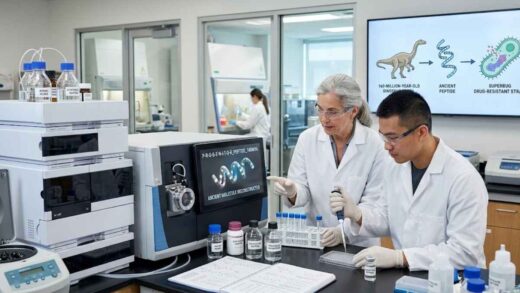
Researchers have reconstructed ancient antimicrobial peptides from mammals that lived around 160 million years ago, and found that some of these “revived” molecules may be better at killing bacteria than modern versions.
The study comes from the University of Oregon and focuses on understanding how natural immune molecules evolved — and whether they can help in the fight against antibiotic-resistant infections.
What the scientists actually did
Instead of digging up fossils, researchers used genetic data to rebuild ancient proteins in the lab.
They:
- Compared gene sequences from living mammals like humans and cows
- Used evolutionary models to reconstruct ancient versions
- Synthesized these proteins in the lab
- Tested them against dangerous bacteria
This technique is called ancestral sequence reconstruction.
What they found
The team studied antimicrobial peptides from a protein called lactoferrin, which is part of the immune system and helps defend against infection.
Key findings:
- Some ancient peptides could damage bacterial membranes
- Later versions became stronger over time
- In some cases, older reconstructed peptides killed bacteria better than modern ones
The bacteria tested included:
- E. coli
- Staphylococcus aureus
- Pseudomonas aeruginosa
- Streptococcus species
A tiny mutation made a big difference
One of the most surprising results was how small the changes were.
Researchers found that:
- A single amino acid mutation could significantly increase antibacterial power
- Evolution fine-tuned these molecules over millions of years
- Even small structural changes dramatically changed effectiveness
Why this matters for medicine
Antibiotic resistance is a growing global problem. Many bacteria are evolving faster than current drugs can handle.
These findings suggest:
- Ancient molecules could inspire new antibiotics
- Natural evolution has already tested many useful designs
- Peptides could become templates for next-generation treatments
The big limitation
Despite the excitement, researchers warn that this is not an immediate drug breakthrough.
Challenges include:
- Peptides break down quickly in the human body
- They are less stable than traditional antibiotics
- More testing is needed before clinical use
So this is still early-stage research, not a treatment yet.
What scientists hope to do next
Researchers believe this approach could help:
- Design stronger antimicrobial peptides
- Predict how bacteria might develop resistance
- Build combination therapies to slow resistance
- Discover new drug candidates inspired by evolution
The idea is to use evolution itself as a guide for future medicine.
Big picture
This study shows that ancient biology may hold clues for modern medicine. By “replaying” evolutionary history, scientists are uncovering molecules that could one day help tackle one of healthcare’s biggest threats: antibiotic-resistant bacteria.