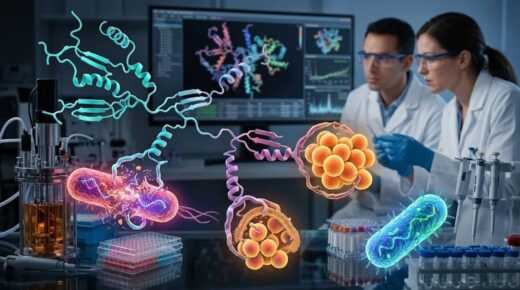
A team at Stanford University has developed a new way to design bacteria-killing materials that could help tackle one of medicine’s biggest problems: antibiotic resistance.
The researchers focused on mimicking antimicrobial peptides, naturally occurring molecules found throughout the human body that can destroy bacteria on contact. Unlike traditional antibiotics, which target specific biochemical pathways, these peptides kill microbes by physically damaging their cell membranes. That makes it far harder for bacteria to evolve resistance.
Why peptides matter — and why they’re not enough
Antimicrobial peptides are effective because they don’t rely on a single target inside the cell. Instead, they disrupt the outer membrane, essentially tearing holes in bacteria. This physical attack is difficult for microbes to adapt to.
But peptides have major limitations. They are expensive to produce, break down quickly in the body, and are difficult to scale for widespread use. That has slowed their adoption as real-world treatments.
The breakthrough: polymers that act like peptides
Instead of trying to improve peptides directly, the Stanford team looked at polymers — long, chain-like molecules that are cheaper, more stable, and easier to manufacture.
Using artificial intelligence, the researchers screened 1.7 million potential polymer candidates to find ones that behave like antimicrobial peptides. The results were promising:
- 10 polymer candidates showed strong antibacterial activity
- All performed better than expected in lab tests
- One was especially effective against biofilms, a major challenge in modern medicine
Biofilms are clusters of bacteria that stick to surfaces and resist most antibiotics, making infections harder to treat.
How AI made it possible
The study, published in Matter, used a novel approach. Because there isn’t much data on antimicrobial polymers, the team trained their model using existing peptide data first, then applied those insights to polymers.
They also used an unusual strategy: instead of choosing molecules that models agreed on, they tested those with the most disagreement. This helped improve the system faster by focusing on uncertain cases.
A different way to fight resistance
Traditional antibiotics often fail because bacteria can mutate a single pathway to survive. These new polymers work differently:
- They attack the cell membrane directly
- They don’t need to enter the cell
- They don’t depend on one biological target
This makes resistance much harder to develop.
The polymers were effective against both:
- Gram-negative bacteria like E. coli
- Gram-positive bacteria such as Staphylococcus aureus
Notably, there has been no new class of antibiotics for Gram-negative bacteria in decades, making this approach especially significant.
What comes next
The research is still early-stage, but it opens the door to custom-designed antibiotics that target specific infections while leaving healthy bacteria untouched.
If successful, polymer-based antimicrobials could offer:
- Lower production costs
- Better stability and shelf life
- Wider global access, including low-resource settings
With antibiotic resistance already causing millions of deaths worldwide each year, the need for new solutions is urgent. This peptide-inspired polymer approach could represent one of the most promising directions yet.