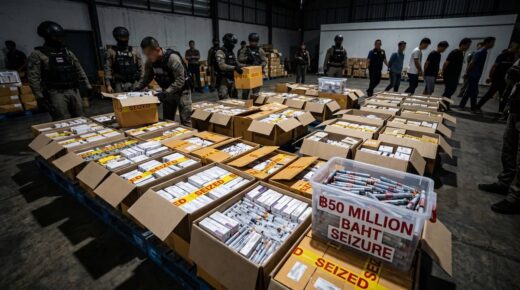
Thai authorities have seized illegal weight-loss injection products worth more than 50 million baht from a house in Nonthaburi, where investigators say the seller was making around 8 million baht a month from online sales.
The raid took place in Bang Yai district after a parent reported concern that her daughter had used an online-purchased injection product called “Haus of Peptides”.
Sold online without approval
According to police and the Food and Drug Administration (FDA), the products had no official registration number and were being sold illegally through social media.
Investigators say the operation had been running for about a year from a rented house in tambon Sao Thong Hin. The seller has not yet been identified.
Authorities also found that migrant workers were hired to pack the products and arrange deliveries through private courier services.
Large-scale online business
Police estimate the business was shipping around 100 boxes per day. Each box sold for about 2,900 baht, generating roughly 290,000 baht in daily income.
That adds up to more than 8 million baht per month in estimated revenue.
In total, the seized goods were valued at around 52 million baht.
Each package reportedly contained injection vials, distilled water for mixing, syringes, instructions, and alcohol wipes.
What the drugs are
The products are believed to be GLP-1 receptor agonists, a class of drugs originally developed to treat type 2 diabetes and later used for medical weight management in people with obesity.
Health officials in Thailand say these drugs are only approved for patients diagnosed with obesity or diabetes and must be prescribed and monitored by doctors. They are not approved for cosmetic weight loss.
Health risks and legal action
Authorities warned that unsupervised use can cause side effects including nausea, vomiting, stomach pain, and more serious risks such as depression, pancreatitis, kidney failure, and potential thyroid complications.
Under Thai law, selling modern drugs without a licence can carry penalties of up to five years in prison and fines.
The investigation is ongoing as police continue to trace those behind the operation.